

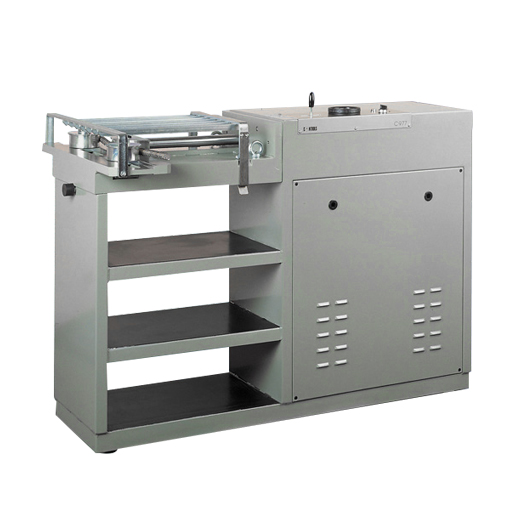
Evaluate the ductility of reinforcing steel with controlled cold bend and re-bend testing
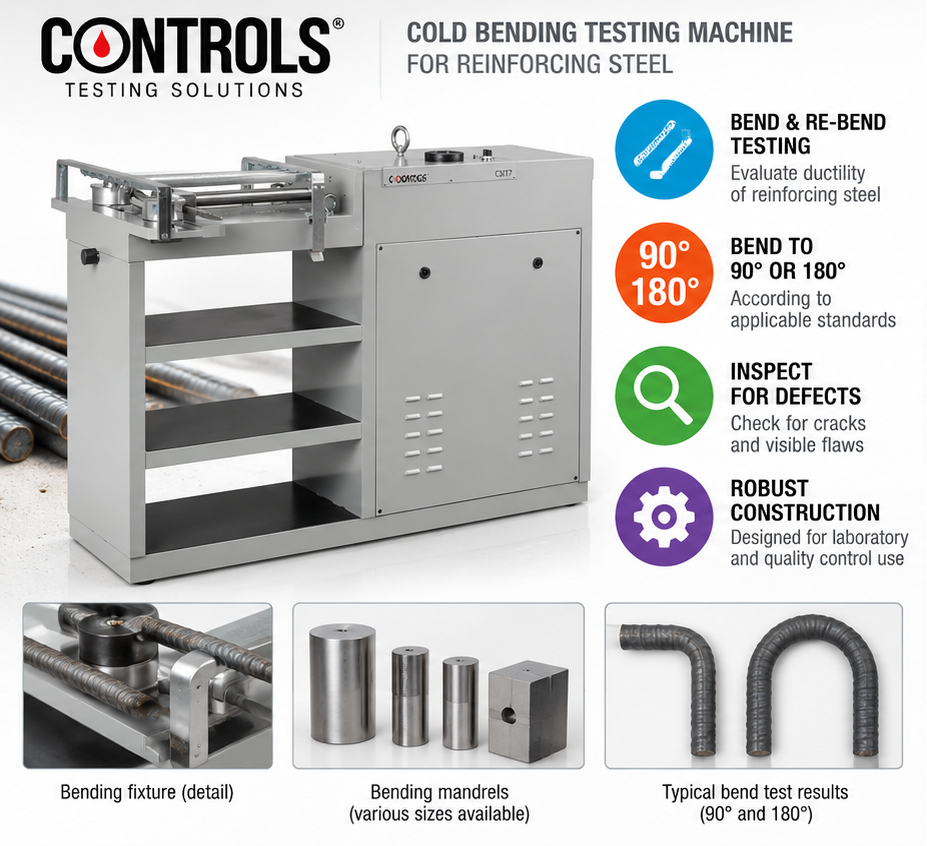
The CONTROLS Cold Bending Testing Machine is designed for bend and re-bend testing of reinforcing steel bars. This type of test provides a simple and rapid qualitative assessment of steel ductility and can help evaluate the effects of strain aging by subjecting the specimen to controlled plastic deformation.
Cold bend testing of reinforcing steel
During a bend test, the reinforcing steel specimen is plastically deformed around a bending mandrel to the angle required by the applicable test procedure. Depending on the test, the bar may be bent to 90° or 180°. After bending, the specimen is visually examined for cracking and other defects that may indicate an increased risk of fracture.
Perform bend and re-bend tests
In addition to conventional bending, the machine is designed for re-bend testing. This procedure subjects the reinforcing bar to a specified initial deformation followed by further manipulation according to the applicable test method. Re-bend testing is particularly useful for assessing the influence of strain aging on the ductility of reinforcing steel.
Assess rebar ductility and detect potential defects
Bend testing does not simply determine whether a bar can be physically bent. It provides a practical means of evaluating the material's ability to undergo plastic deformation without developing unacceptable cracking or other visible defects. After completion of the test, the bent area is inspected for indications that could increase the risk of steel fracture.
Designed for construction-materials and steel testing laboratories
The machine is intended for laboratories performing quality control and mechanical testing of reinforcing steel used in concrete construction. It provides a dedicated setup for carrying out repeatable bend and re-bend procedures without adapting a general-purpose testing machine for each test.
Interchangeable bending accessories
Cold bending requirements vary according to the diameter and type of reinforcing bar and the applicable test specification. The appropriate bending mandrel and supporting components are therefore selected according to the specimen and required test configuration.
Frequently Asked Questions
What does a cold bend test tell you about reinforcing steel?
A cold bend test provides a qualitative assessment of the steel's ductility. The specimen is plastically deformed to a specified angle and then inspected for cracks or other defects that could indicate an increased susceptibility to fracture.
What is the difference between a bend test and a re-bend test?
A bend test evaluates the behaviour of the steel during a specified initial bend. A re-bend test includes additional deformation after the initial bending procedure and can be used to evaluate the effects of strain aging on reinforcing steel.
Are reinforcing bars heated during a cold bending test?
No. The test is described as cold bending because the specimen is mechanically bent without heating it as part of the bending operation. Any conditioning required by a particular re-bend procedure should follow the applicable testing standard.
Why are different bending mandrels required?
The required bending diameter depends on factors such as the reinforcing-bar diameter and the applicable product or test standard. Using the appropriate mandrel establishes the specified bend radius for the specimen.
| MANDRELS Table II | |||
| Specimen dia. | Mandrel dia. | Roller dia. | Distance between rollers |
| deformed surface | deformed surface | ||
| FeD 44K | FeB 44K | ||
| 5 mm | 20 mm | 50 mm | 35 mm |
| 6 mm | 24 mm | 50 mm | 42 mm |
| 8 mm | 32 mm | 50 mm | 56 mm |
| 10 mm | 40 mm | 50 mm | 70 mm |
| 12 mm | 48 mm | 100 mm | 84 mm |
| 14 mm | 112 mm | 100 mm | 154 mm |
| 16 mm | 128 mm | 100 mm | 176 mm |
| 18 mm | 144 mm | 100 mm | 198 mm |
| 20 mm | 200 mm | 100 mm | 260 mm |
| 22 mm | 220 mm | 100 mm | 286 mm |
| 25 mm | 250 mm | 100 mm | 325 mm |
| 28 mm | 336 mm | 100 mm | 420 mm |
| 32 mm | 384 mm | 100 mm | 480 mm |
| Note: The specimens marked in red must be bent to 180°, while those marked in blue must be bent to 90° then straightened for minimum 20°. ASTM specifications require 100 mm dia. rollers only and the straightening test is not required. | |||
| Cat. No. | Description | |||
| 70-C977 | Cold bend testing machine 12 t cap.; 220V, 50 Hz, 1 ph. | |||
| 70-C977/Z | Cold bend testing machiine 12 t cap.; 110V, 60Hz, 1 ph. | |||
| Accessories | ||||
| Mandrels | All available mandrels are listed in Table I | |||
| 70-C977/60 | Mandrel holder for mandrels to 20 mm dia. | |||
| 70-C977/61 | Mandrel holder for mandrels from 24 to 50 mm dia. | |||
| 70-C977/62 | Mandrel holder for mandrels from 54 to 96 mm dia. | |||
| 70-C977/K1 | Recommended set of spares comprising jack sealing, switch, pilot lamp and pressure gauge 0-16 tons cap. | |||
| 70-C977/R22 | 100 mm dia. roller | |||
Do you have a question?
min 10 ch