

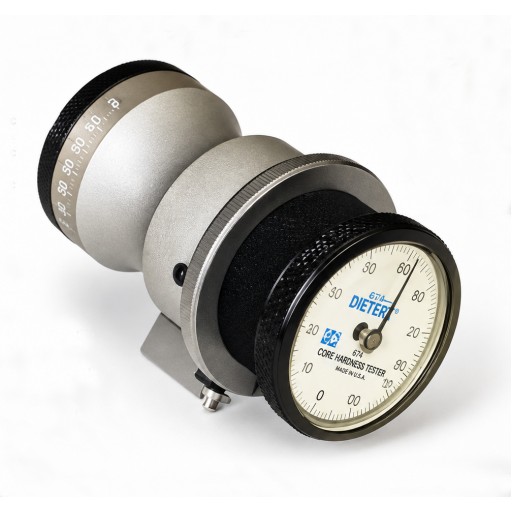
Measure surface and sub-surface hardness of foundry cores and dry sand molds
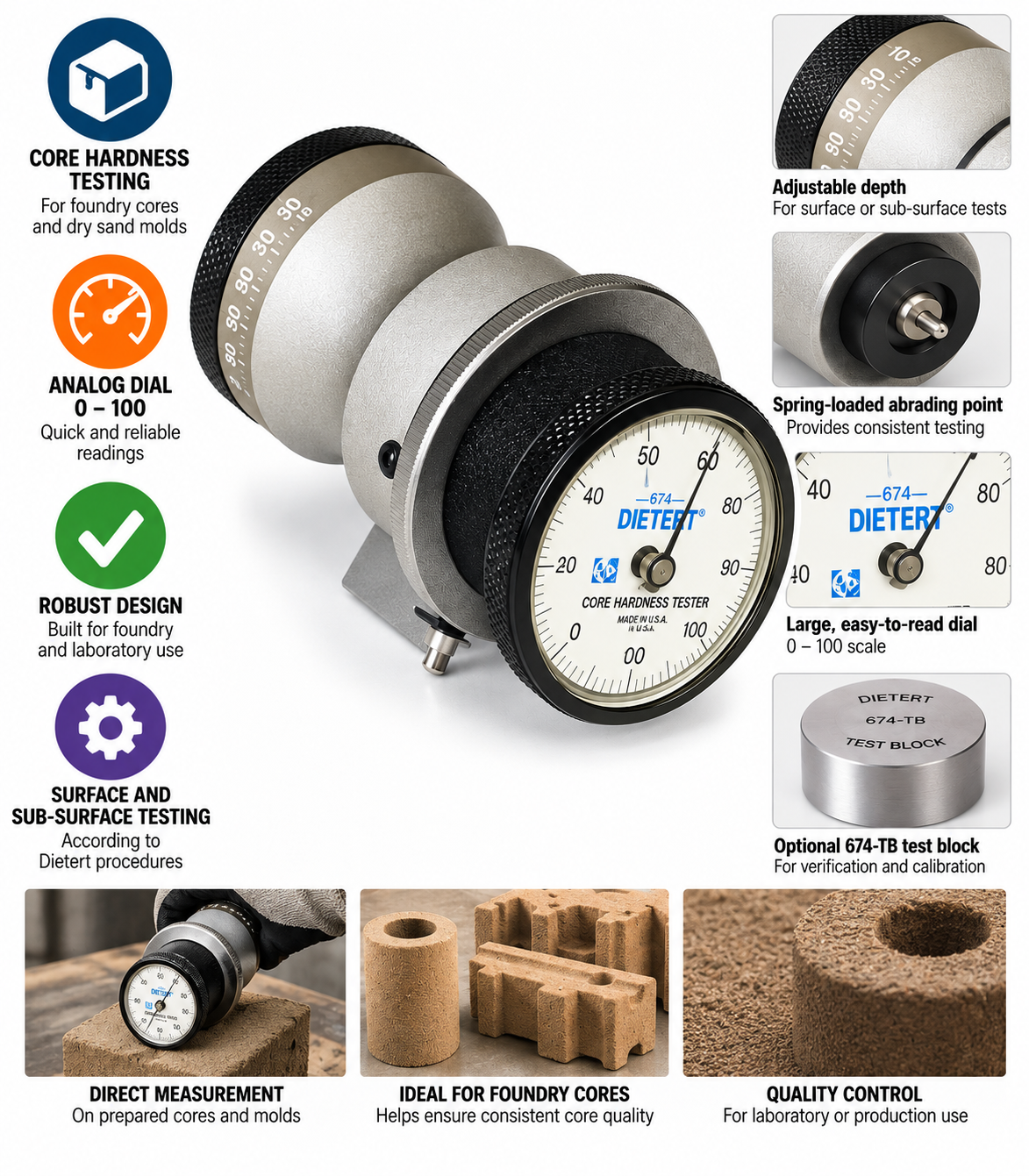
The Dietert No. 674 Core Hardness Tester is a compact, portable instrument designed for measuring the surface and sub-surface hardness of baked foundry cores and dry sand molds. Once acceptable hardness limits have been established for a particular core, the tester provides a practical way to check production cores and monitor consistency directly in the foundry or laboratory.
Monitor core quality during production
Hardness measurements can help identify variations in the degree of bake or cure of a core. Dietert also notes that changes in hardness can, in many cases, reflect an absence or excess of ingredients in the core mixture, making the Model 674 useful as part of routine foundry process control.
Detect variations below the surface
The instrument is designed to evaluate both surface and sub-surface hardness. This capability is particularly useful when investigating differences in density or curing through the outer portion of a core rather than relying only on its visible surface condition.
Identify blocked vents and blow holes
According to Dietert, the Model 674 can be used to detect blockage of vents or blow holes that affect surface density and hardness. These measurements provide another practical means of identifying inconsistencies in manufactured cores before they are put into service.
Spring-loaded abrading measurement principle
The hardness test uses three abrading points loaded by a calibrated spring at constant pressure. With the lower end of the instrument held against the sand surface, the abrading points are rotated through three revolutions in a 3/8 in. diameter circle. The indicated hardness is determined by the depth to which the points penetrate the core material.
On this measurement system, zero penetration corresponds to the maximum hardness value of 100. A penetration depth of 0.250 in. corresponds to a hardness value of 0, with intermediate penetration depths represented by intermediate dial readings.
Portable instrument for production and laboratory checks
Dietert describes the No. 674 as a practical pocket-sized tester. Its compact mechanical design allows it to be carried between production areas and used on a wide range of cores manufactured using traditional or newer core-making methods.
Optional 674-TB test block
The optional Dietert No. 674-TB Test Block is manufactured from a consistent material and is used to help determine the calibration status of the No. 674 Core Hardness Tester. It provides a convenient reference for periodic instrument checks.
Specifications
| Manufacturer | Dietert Foundry Testing Equipment |
|---|---|
| Model | No. 674 |
| Measurement | Surface and sub-surface core hardness |
| Materials | Baked foundry cores and dry sand molds |
| Measurement principle | Spring-loaded rotating abrading points; hardness indicated by penetration depth |
| Hardness indication | 0 to 100 |
| Height | 3 in. (76 mm) |
| Maximum diameter | 2 1/8 in. (54 mm) |
| Optional accessory | Dietert 674-TB Test Block |
Frequently Asked Questions
What does the Dietert 674 measure?
It measures the relative surface and sub-surface hardness of baked foundry cores and dry sand molds. The reading is based on the penetration produced by spring-loaded abrading points.
Can the tester help identify improper curing?
Yes. Dietert states that hardness measurements can indicate variations or errors in the degree of bake or cure and may also reflect variations in the ingredients used to produce a core.
Why measure sub-surface hardness as well as surface hardness?
Testing below the immediate surface can reveal hardness and density variations that may not be apparent from the exterior alone. Dietert specifically designed the No. 674 for both surface and sub-surface measurements.
Can the Dietert 674 help find blocked vents?
Yes. Dietert identifies blocked vents and blow holes as conditions that can affect surface density and hardness and states that the instrument can be used to help detect these conditions.
How can the calibration status of the tester be checked?
The optional Dietert 674-TB Test Block is made from a consistent material and is intended to help determine the calibration status of the No. 674 Core Hardness Tester.
Do you have a question?
min 10 ch