

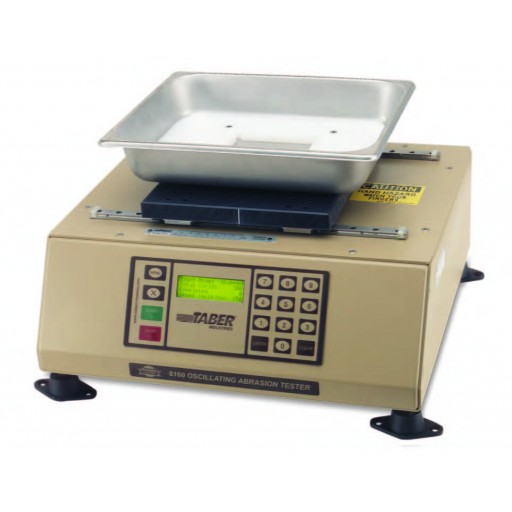
Measure resistance to abrasion and scratching with oscillating abrasive media
The Taber 6160 Oscillating Sand Abrasion Tester is designed to measure the relative resistance of materials to surface abrasion, scratching and marring. The instrument subjects the specimen to moving abrasive media, producing a random pattern of surface damage that helps simulate the effects of everyday abrasive wear.
Oscillating sand abrasion method
The specimen is mounted in a holder at the bottom of a detachable tray and covered to a uniform depth with standardized abrasive media, such as quartz silica or alumina. A scotch-yoke drive system moves the tray back and forth, causing the abrasive media to shift across the specimen surface and generate scratches, pits and surface roughening.
Designed for transparent materials and coatings
The primary application of the Taber 6160 is evaluating transparent plastics and coatings used for windows, lenses and similar products. It can also be used to investigate the abrasion resistance of organic paints and coatings, plastics, metals and other suitable rigid materials.
Adjustable speed and stroke length
Test conditions can be adapted to different procedures with an adjustable stroke length from approximately 6.5 to 150 mm (0.25 to 6 in) and a variable operating speed from 100 to 200 cycles per minute. This flexibility allows the tester to accommodate standardized methods as well as comparative laboratory testing.
Accommodates rigid specimens
The standard specimen holder is intended for flat, rigid specimens measuring 100 mm square and less than 12.5 mm (0.5 in) thick. Custom specimen holders can also be developed for materials with non-standard shapes, although specimen geometry can affect how the abrasive media moves across the surface.
ASTM F735 abrasion testing
The Taber 6160 is used for testing according to ASTM F735, which evaluates the abrasion resistance of transparent plastics and coatings using the oscillating sand method. Under the ASTM procedure, the sand tray travels 100 mm at 150 cycles per minute (300 strokes per minute).
Additional abrasion and erosion testing
Different abrasive media can be used depending on the test procedure, including quartz silica and alumina. The instrument can also be configured with an optional kit for Bayer abrasion testing of contoured lenses. Abrasive slurry may be used for small-scale controlled evaluation of material erosion resistance.

Do you have a question?
min 10 ch