

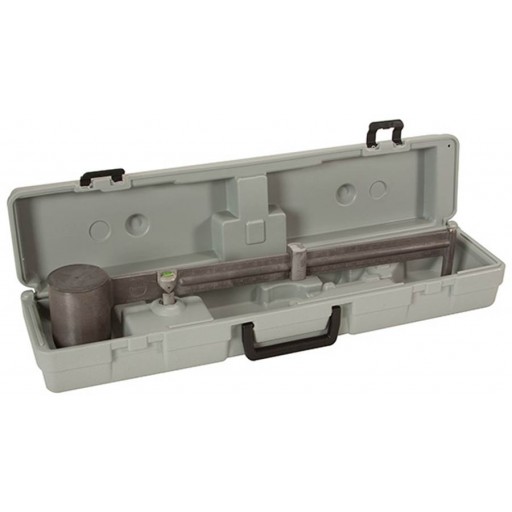
Quick field measurement of drilling fluid and slurry density
The Baroid Mud Balance provides a simple and direct method for determining the density, or mud weight, of drilling fluids and slurries. Designed for routine field and laboratory measurements, the balance allows drilling personnel to monitor an important fluid property without requiring electronic instrumentation.
Direct measurement of drilling fluid density
The mud balance determines the weight of a known volume of fluid. A sample is placed in the balance cup and the sliding rider is adjusted along the graduated beam until the instrument reaches equilibrium. The density can then be read directly from the corresponding scale on the beam.
Useful for drilling fluid control
Fluid density is an important parameter when evaluating and maintaining drilling fluids. Monitoring mud weight helps operators identify changes in the fluid system and provides useful information when adjusting fluid properties for drilling conditions.
Monitor solids loading in drilling slurries
In horizontal directional drilling applications, Baroid notes that fluid or slurry density can be used as an indicator of solids content. Comparing density measurements can help evaluate the amount of drilled solids entering the return fluid and can also provide useful information when assessing the effectiveness of solids-control and recycling equipment.
Mechanical design for field use
The mechanical balance principle makes the instrument well suited to field measurements where a straightforward test is preferred. Once the sample has been loaded and the beam balanced, the operator obtains a direct density reading without calculations or electronic measurement equipment.
Typical Test Procedure
- Fill the sample cup with the drilling fluid or slurry to be tested.
- Fit the lid and remove excess material from the outside of the cup.
- Place the balance on its support and move the rider along the graduated beam.
- Adjust the rider until the beam reaches its balanced position.
- Read the fluid density from the appropriate graduation on the beam.
Specifications
| Manufacturer | Baroid |
|---|---|
| Product Type | Mud balance |
| Measurement | Drilling fluid and slurry density / mud weight |
| Measurement Principle | Mechanical balance of a known fluid volume |
| Typical Applications | Drilling fluid testing, field fluid control and slurry monitoring |
| Operation | Manual |
Frequently Asked Questions
What does a mud balance measure?
A mud balance measures the density, commonly called mud weight, of a drilling fluid or slurry. The measurement provides a quick indication of how heavy the fluid is for a given volume.
Why should drilling fluid density be monitored?
Density can change as solids enter the drilling fluid or as the fluid formulation is adjusted. Regular measurements therefore provide useful information for monitoring the condition of the drilling fluid during operations.
Can a mud balance be used to monitor solids content?
It can provide useful information about solids loading. Baroid specifically describes slurry density as a measurement that can be used to estimate solids content in horizontal directional drilling and to help evaluate solids-control equipment.
Does the Baroid Mud Balance require electricity?
No. The instrument operates mechanically by balancing the filled sample cup against an adjustable rider on the graduated beam.
Is a mud balance the same as a Marsh Funnel?
No. The two instruments measure different drilling-fluid properties. A mud balance measures fluid density or mud weight, while a Marsh Funnel is used to measure flow time as an indication of drilling-fluid viscosity.
Do you have a question?
min 10 ch