

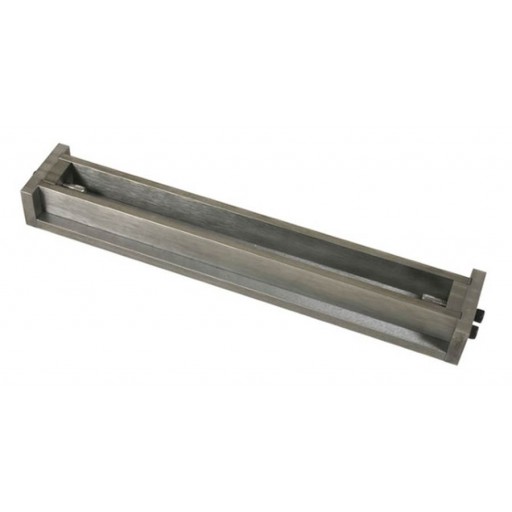
Humboldt H-3253 Cement Prism Mold, 1 × 1 × 10 in – 2-Mold
- Humboldt - HU3252
ASTM C151, ASTM C157, ASTM C227, ASTM C311, ASTM C342, ASTM C441...
Prepare two 1 × 1 × 10 in cement and mortar prisms for standardized length-change testing
The Humboldt H-3253 Cement Prism Mold is a two-cavity mold designed to prepare 1 × 1 × 10 in (25 × 25 × 254 mm) prism specimens for cement and mortar testing. Manufactured from cold-rolled steel, it allows two specimens to be molded simultaneously and is used with a range of ASTM methods for evaluating dimensional change, expansion, shrinkage and potential aggregate reactivity.
Two-cavity design for efficient specimen preparation
The H-3253 forms two prism specimens at the same time. Each cavity produces a 1 × 1 × 10 in (25 × 25 × 254 mm) specimen, making the mold suitable for laboratory procedures that require multiple mortar bars or cement prisms to be prepared under comparable conditions.
Cold-rolled steel construction
The H-3253 is manufactured from cold-rolled steel. Humboldt also offers the H-3253S with the same specimen dimensions and two-cavity configuration in stainless steel; the standard H-3253 should therefore be identified specifically as the cold-rolled-steel version.
For cement and mortar length-change measurements
The mold is used to prepare specimens for tests that monitor changes in length after exposure to specified curing, environmental or chemical conditions. Depending on the applicable test method, these measurements can be used to evaluate properties such as drying shrinkage, cement expansion, sulfate-related expansion or potential alkali-aggregate reactivity.
Supports multiple ASTM test methods
Humboldt lists the H-3253 for numerous standardized test procedures, including ASTM C1260, C151, C157, C227, C342, C441, C452, C490 and C596. This makes the same mold useful across several cement, mortar and aggregate testing procedures rather than limiting it to a single test method.
Compatible with gauge studs and length comparators
For applicable length-change procedures, Humboldt pairs the H-3253 with H-3260 gauge studs for mortar bars and suitable specimen length comparators. The exact supporting equipment required depends on the ASTM procedure being performed.
Specifications
| Manufacturer | Humboldt |
|---|---|
| Model | H-3253 |
| Product Type | Cement prism mold |
| Specimen Size | 1 × 1 × 10 in |
| Metric Specimen Size | 25 × 25 × 254 mm |
| Number of Cavities | 2 |
| Material | Cold-rolled steel |
| Applications | Cement and mortar prism preparation for length-change, expansion, shrinkage and related tests |
| Standards Listed by Humboldt | ASTM C1260, C151, C157, C227, C342, C441, C452, C490 and C596 |
Frequently Asked Questions
How many specimens can the Humboldt H-3253 mold at once?
The H-3253 is a two-cavity mold, so it prepares two 1 × 1 × 10 in (25 × 25 × 254 mm) prism specimens simultaneously.
What is the difference between the H-3253 and H-3252?
Both produce 1 × 1 × 10 in specimens and are manufactured from cold-rolled steel. The H-3252 is a single-cavity mold, while the H-3253 has two cavities and prepares two specimens at the same time.
What is the difference between H-3253 and H-3253S?
Both are two-cavity molds for 1 × 1 × 10 in specimens. The H-3253 is manufactured from cold-rolled steel, while the H-3253S is the stainless-steel version.
Can the H-3253 be used for ASTM C157 length-change testing?
Yes. Humboldt specifically lists the H-3253 as part of the equipment for ASTM C157, which covers length change of hardened hydraulic-cement mortar and concrete.
Can this mold be used for alkali-aggregate reactivity testing?
Yes. Humboldt lists the H-3253 for ASTM C1260 and ASTM C227 mortar-bar procedures used to evaluate potential alkali reactivity.
Are gauge studs required?
Gauge studs are used with the mold for applicable length-change procedures. Humboldt lists its H-3260 gauge studs for mortar bars alongside the H-3253 in several ASTM equipment configurations. The complete equipment required depends on the specific test method.
Do you have a question?
min 10 ch