



Refractometers / Polarimeters
Refractometers and polarimeters for quality control in the food and beverage industry. Discover our products from Atago and Hanna.
Comparison of Refractometers and Polarimeters
| INSTRUMENT TYPE | BEST SUITED FOR | WHAT IT MEASURES | KEY ADVANTAGE | KEY CONSIDERATION |
|---|---|---|---|---|
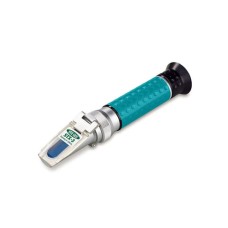
| Optical Handheld Refractometer | Quick routine checks in production, receiving areas or the field | Refractive index expressed on a scale such as °Brix | Simple, portable measurement without electronics | Measurement range, scale, temperature compensation and visual reading |
| Digital Handheld Refractometer | Fast routine measurements requiring an easy-to-read digital result | Refractive index, °Brix or application-specific scales depending on the model | Reduces subjective interpretation of an optical scale | Required scale, measurement range, accuracy, sample volume and temperature compensation |
| Benchtop Refractometer | Laboratory and quality-control applications requiring higher precision or repeatability | Refractive index, °Brix and other concentration scales depending on the instrument | Designed for controlled, repeatable laboratory measurements | Accuracy, temperature control, measurement range, sample characteristics and available scales |
| Application-Specific Refractometer | Routine testing of products such as beverages, honey, food ingredients or other defined sample types | A concentration or product-specific scale derived from refractive index | Provides results directly on a scale relevant to the application | The selected scale must correspond to the product and measurement method |
| Digital Polarimeter | Sugar, pharmaceutical, chemical and other optically active samples | Optical rotation; some instruments also calculate specific rotation or concentration | Measures optical activity that cannot be determined from refractive index alone | Wavelength, tube length, temperature, sample concentration and required measurement range |
How to Choose a Refractometer
What Brix range should the refractometer cover?
Choose a measurement range that comfortably covers the expected concentration of your samples. A general-purpose 0–50% Brix instrument may suit many dilute samples, while syrups, concentrates and other high-solids products can require ranges approaching 100% Brix. Avoid selecting a wider range than necessary when accuracy and resolution within a narrower working range are important.
Do I need Brix or refractive index measurement?
Brix is commonly used for sugar solutions and for process control in food and beverage applications, while refractive index (nD) is useful when the measurement must be reported directly as a physical optical property or converted using a product-specific relationship. For samples containing substantial amounts of dissolved substances other than sucrose, a Brix reading represents an apparent Brix value rather than a direct measurement of sugar content.
When is automatic temperature compensation important?
Refractive index changes with temperature, so temperature control or compensation becomes important when samples are measured at different temperatures. Automatic temperature compensation can simplify routine Brix measurements, but its applicable temperature range and compensation method should be checked for the sample being tested. For higher-accuracy work, an instrument with controlled measurement temperature may be preferable.
Can difficult samples require a specialized refractometer?
Yes. Dark, opaque, viscous, fatty, highly concentrated or hot samples can be more demanding than clear aqueous solutions. When working with products such as oils, dairy products, syrups or hot process samples, check that the refractometer's optical system, sample stage, temperature range and measurement method are suitable for that specific sample type.
How much accuracy and resolution do I actually need?
Resolution determines the smallest displayed increment, while accuracy indicates how closely the measurement can represent the actual value. They should not be treated as interchangeable specifications. For routine concentration checks, very fine resolution may offer little practical advantage, while quality-control or laboratory methods may require substantially tighter accuracy and repeatability.
Should the refractometer be calibrated with water or a reference solution?
Water calibration is convenient for instruments and measurement ranges that permit it, but it does not verify performance across the entire working range. For measurements at higher Brix values or where traceable quality-control procedures are required, appropriate certified refractive-index or Brix reference standards may provide a more meaningful verification point.